Web and Android Technical Audit Before Scaling
A product built with AI coding tools may work for a few users but struggle to scale. Mad Devs assessed a working B2B platform before wider adoption, uncovering critical security vulnerabilities, synchronization failures, and infrastructure limitations that could affect its reliability and growth.
Overview
AI coding tools have made it possible to build functional software without years of engineering experience. A founder or a small team can use AI assistants to develop features, connect services, and launch a working product. But what works in a demo or with a handful of users may not hold up when the system faces concurrent requests, larger data volumes, interrupted operations, and real production failures.
The challenge is no longer just getting code to work. It's knowing whether the system behind it is engineered to handle real-world use. Security, architecture, data consistency, testing, and recovery require decisions that AI-generated code alone cannot guarantee.
That gap between a functional product and a reliable system was the focus of a technical audit Mad Devs conducted for a B2B platform combining a web application, backend services, and an Android client. The platform already supported project management, media processing, offline operations, and data synchronization.
Before expanding its use, the client needed experienced engineers to look beyond working features and identify what could break, what posed security risks, and what would limit future growth.
Mad Devs reviewed the platform's architecture, security, infrastructure, code quality, deployment processes, and scalability. The assessment also included a separate Android review and documented manual testing results, turning hidden technical weaknesses into a prioritized plan for improvement.
Project at a glance
2 codebases
Web/backend platform and Android application reviewed
1 vulnerability
Critical server-side file-handling risk requiring immediate attention
9 QA issues
User-flow problems documented through manual testing
6 priority issues
Synchronization, data access, and workflow failures identified
71 errors/223 warnings
Android lint findings from static analysis
152–260 hours
Preliminary effort for the first phase of Android remediation
Challenges and solutions
Four challenges shaped this audit: identifying security gaps, assessing offline synchronization failures, evaluating infrastructure limitations before scaling, and uncovering quality assurance issues hidden behind successful builds.
Challenge 1: Working authentication did not guarantee consistent security
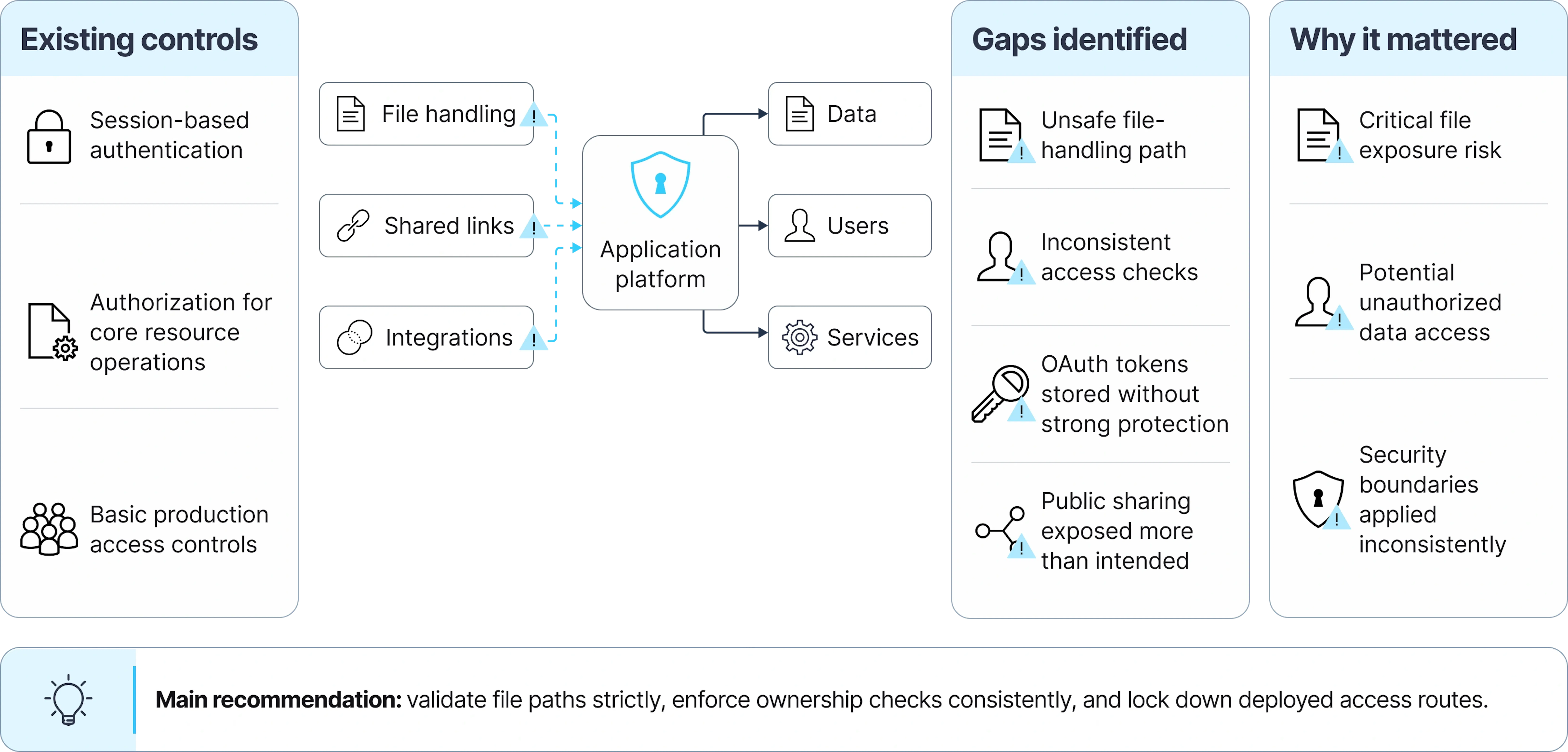
The platform already used established authentication mechanisms and included authorization checks for core resource operations. However, these protections were not consistently applied across API endpoints, file operations, and third-party integrations.
The most serious finding involved a media-processing endpoint that could allow unauthorized access to files outside its intended storage directory. Because the affected functionality was also accessible through public resource-sharing workflows, the vulnerability received critical P0 priority.
We also identified incomplete access checks, insufficient protection of stored authentication tokens, and sharing mechanisms that could expose more resources than users intended.
These weaknesses were not immediately obvious from normal application behavior. Users could authenticate and work with resources successfully, while certain backend operations still exposed sensitive data.
Our solution
Mad Devs reviewed source code, API routes, authentication flows, and production configurations to identify where security boundaries were missing or inconsistently enforced.
We recommended stricter input validation, consistent resource-ownership checks, encrypted token storage, and explicit controls for publishing and revoking shared resources.
The assessment also identified application interfaces exposed outside the intended reverse-proxy protections. We recommended restricting access to internal services and validating security settings in the deployed environment, not only in repository configurations.
The findings demonstrated why a working authentication flow is not sufficient evidence of application security. Engineering reviews need to evaluate how protection is enforced throughout the system, including less visible operations and edge cases.
Challenge 2: Offline synchronization failed in real user workflows
The Android application allowed users to collect information without a stable internet connection and synchronize it with the backend later. Although the core functionality existed, the synchronization architecture introduced reliability risks.
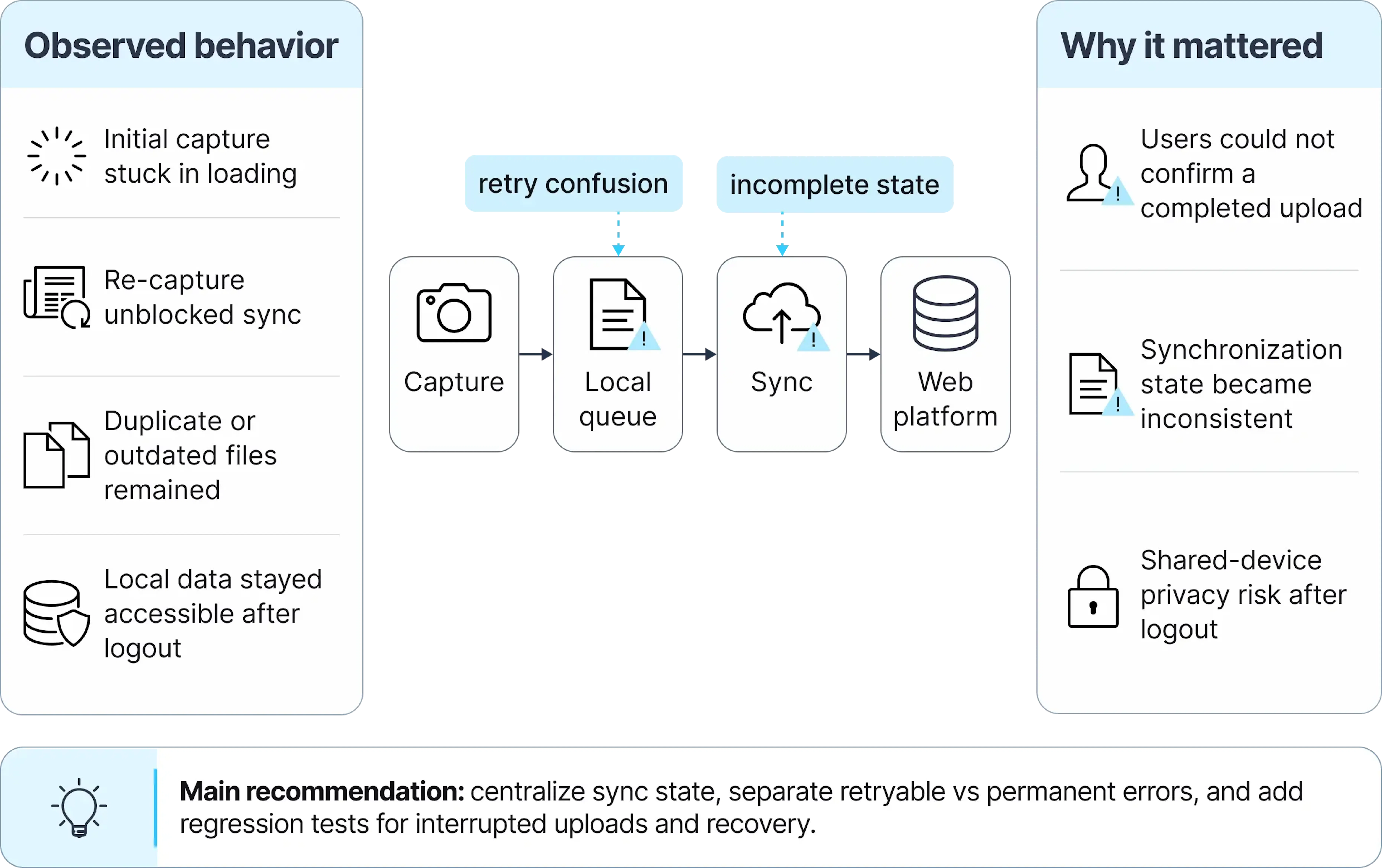
Pending operations were managed across multiple components, while locally stored queues lacked robust recovery and versioning mechanisms. API error handling also failed to distinguish some temporary connection problems from permanent errors, potentially triggering ineffective retries or leaving operations incomplete.
Manual testing confirmed problems that directly affected users. Initial data capture could remain stuck in a loading state without completing synchronization. Repeating the operation could unblock the process but leave duplicate or outdated files. Local project data also remained accessible after logout.
These failures demonstrated the difference between implementing a feature and ensuring it behaves reliably across interrupted operations, retries, and changes in application state.
Our solution
Mad Devs analyzed the synchronization architecture, local storage, API contracts, and error-handling mechanisms, comparing the technical implementation with confirmed user-facing failures.
We recommended centralizing synchronization state, introducing versioned queue storage and atomic updates, and separating retryable errors from failures requiring user intervention.
The remediation plan also included automated regression tests for interrupted uploads, repeated operations, and data recovery, together with stronger controls over locally stored data.
The tested Android build received a No-Go recommendation for pilot acceptance until the high-priority limitations were resolved or explicitly accepted. This gave the client a concrete understanding of which core workflows still required engineering work before broader use.
Challenge 3: Infrastructure designed for a small workload created risks for growth
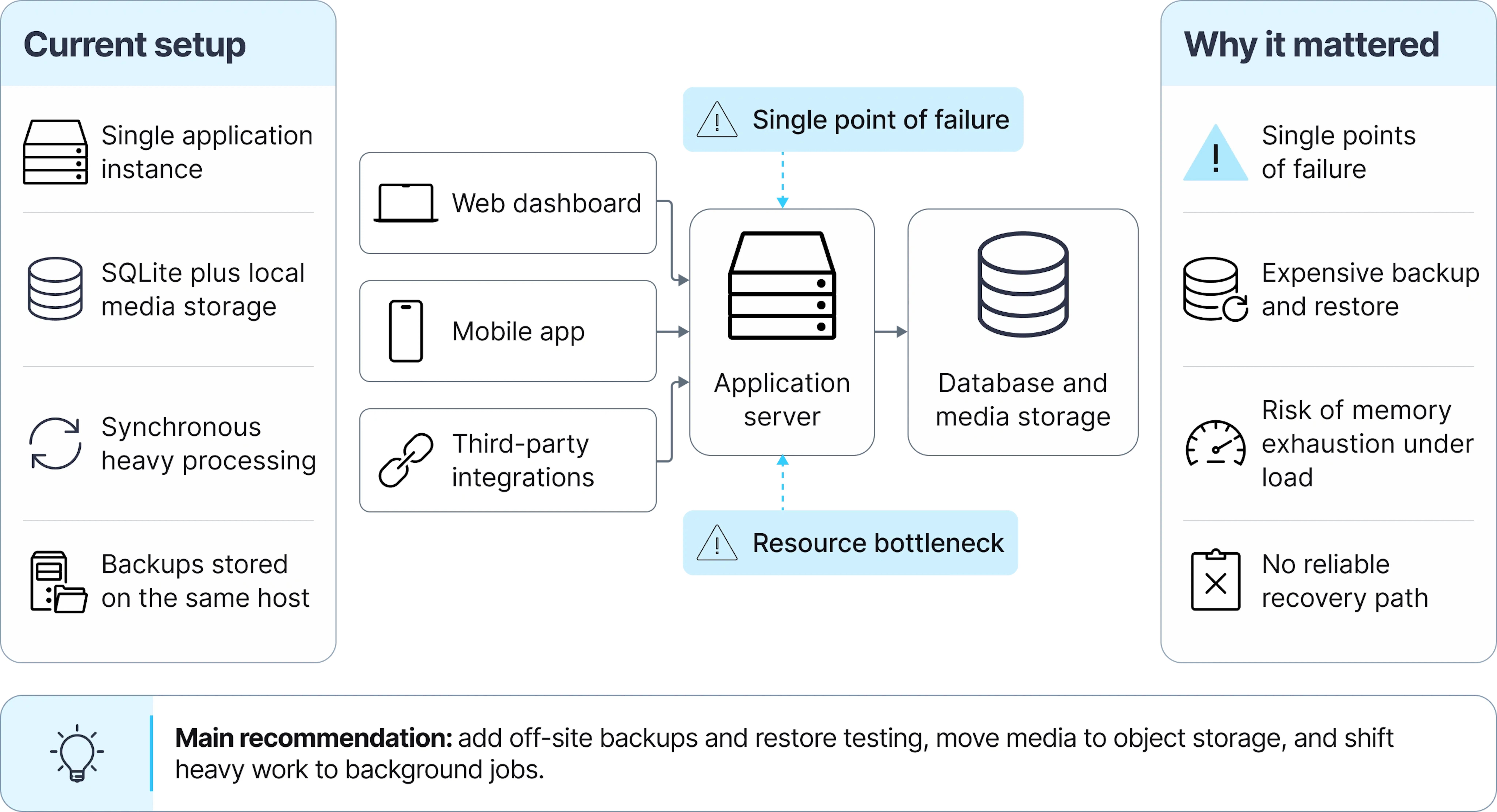
The platform relied on a single application instance, a file-based database, and local media storage. This architecture was relatively simple to operate, but it created limitations for reliability and future scaling.
Large media files were stored directly in the database, increasing its size and complicating backups. Resource-intensive processing ran synchronously within application requests, creating a risk of excessive memory consumption when multiple heavy operations occurred.
The audit also found that backups were stored on the same host, created irregularly, and lacked a tested restoration procedure. A serious server or storage failure could therefore affect both production data and the available backups.
These limitations illustrated an important engineering trade-off: an architecture sufficient for initial use may become increasingly difficult to operate as data volumes, concurrent requests, and availability requirements grow.
Our solution
Mad Devs reviewed the deployment architecture, storage model, resource consumption, backup procedures, and operational configuration to identify single points of failure and scaling limitations.
For near-term reliability, we recommended regular off-site backups, tested recovery procedures, operational alerts, and safer deployment practices.
For future growth, the roadmap proposed separating binary media from the database, moving resource-intensive processing into background job queues, improving database indexing, and preparing the platform for multiple application instances.
The goal was not to introduce unnecessary complexity or rebuild the entire system. It was to establish which architectural changes were essential for reliable operation and which could be implemented as the product expanded.
Challenge 4: Successful builds concealed missing quality assurance
One of the clearest examples of the gap between working software and production readiness came from the Android build process.
The application compiled successfully, but its automated test tasks completed without executing actual tests. A green build therefore provided no meaningful confirmation that critical business workflows had been verified.
Static analysis revealed numerous code issues, while large application components combined interface logic, networking, local storage, and synchronization responsibilities. This structure made individual changes harder to isolate and test.
The backend delivery process showed similar weaknesses. Automated quality checks were not consistently enforced before deployment, and releases lacked a reliable rollback procedure.
An operational inspection revealed another problem: a native media-processing dependency failed to load in production. The application silently switched to a less suitable processing method, resulting in degraded output without completely stopping.
Our solution
Mad Devs examined build configurations, static-analysis results, test coverage, deployment processes, and runtime behavior.
We recommended introducing automated tests for critical workflows, enforcing meaningful quality gates in CI/CD, and separating responsibilities within large application components.
For deployment, we proposed versioned releases, reliable rollback mechanisms, and runtime checks for required dependencies.
The assessment demonstrated why successful compilation is only a starting point. Production readiness also requires evidence that important workflows behave correctly, errors are handled predictably, and the system can be maintained and recovered when something goes wrong.
Key results
- Critical security risk identified. Mad Devs uncovered a P0 server-side vulnerability and additional access-control weaknesses requiring remediation.
- Mobile release readiness assessed. Confirmed user-flow failures supported a No-Go recommendation for the tested Android build pending remediation or explicit acceptance.
- Scalability limitations identified. The review revealed single points of failure, resource bottlenecks, and inadequate recovery arrangements.
- Quality assurance gaps exposed. Successful builds concealed missing automated tests, while operational inspection revealed runtime problems not apparent from source-code analysis alone.
- Remediation roadmap delivered. Findings were classified from P0 to P3 and accompanied by technical recommendations and preliminary engineering estimates.
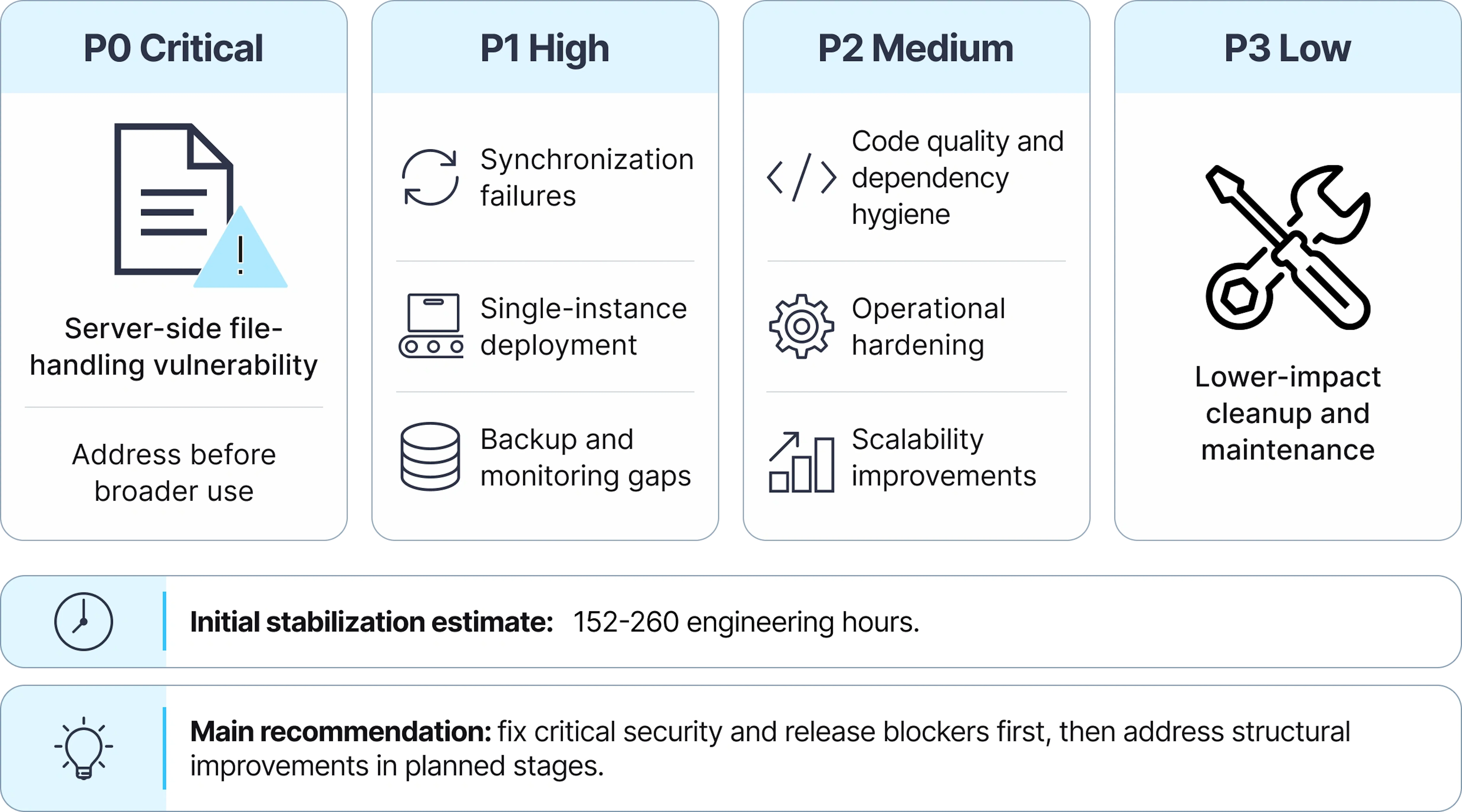
The audit helped the client understand which risks required immediate attention, where additional engineering expertise was needed, and what to prioritize before scaling the product.
When a working product needs engineering expertise
AI-assisted development can dramatically accelerate the journey from an idea to a functional product. Small teams can implement features, connect services, and build working applications with fewer resources than traditionally required.
But there is a difference between generating code that performs a task and engineering a system that can operate reliably as requirements grow.
Security boundaries, concurrent operations, data consistency, recovery procedures, and deployment reliability require deliberate technical decisions and validation. Problems in these areas are not unique to AI-generated code, but they can be overlooked when development focuses primarily on delivering working features.
This case demonstrates why independent engineering reviews matter before scaling. Mad Devs helped the client look beyond visible functionality, identify risks across the entire system, and understand what additional work was necessary for reliable operation.
For teams building products with AI coding tools, the first step can be identifying potential issues directly in the codebase, before they turn into bigger production problems.
|
Find the risks behind working AI-generated code Our product, Enji Guard, helps teams assess whether their code is ready for production. It analyzes repositories for security vulnerabilities, testing gaps, dependency issues, and technical debt, providing actionable findings to help prioritize improvements before scaling. Get a repo readiness report → |
Code-level checks are a useful starting point, but production readiness goes further. Architecture, infrastructure, deployment, and real-world workflows also need engineering oversight. A comprehensive technical audit helps connect these findings and establish what needs to be addressed before wider rollout.
Building a working product is easier than ever. Making it secure, reliable, and ready to scale still requires engineering expertise.
Meet the team

Ruslan Kasymov
Delivery manager

Anton Kozlov
Architecture engineer

Sergey Kolobov
DevOps engineer

Rustom Kulbatyrov
Mobile developer


